
SBI Clerk Syllabus: The SBI Clerk Exam is one of the most popular banking exams in India. This exam is conducted by the State Bank of India for the post of Junior Associate. Every year, millions of students apply for this exam, as getting a job at SBI is considered a secure and respectable career. This job offers a good salary, opportunities for promotion, and a good work-life balance.
After becoming an SBI Clerk, the candidate has to deal with customers at the branch level. This includes cash handling, account opening, passbook entry, online services, and daily banking-related work.
The most important thing to clear this exam is to understand the SBI Clerk Syllabus thoroughly. Preparing without knowing the syllabus proves to be a waste of time. Therefore, in this article, we will explain the SBI Clerk Syllabus in a very simple and clear language.
Complete Information on SBI Clerk Syllabus
The SBI Clerk Selection Process is completed in three stages. Each stage has its own importance, and the final selection is based on these stages. The first stage is the Preliminary Exam, which is considered qualifying in nature. This means that the marks from the Prelims are not added to the final merit list, but clearing the Prelims is mandatory.
The second stage is the Main Exam, which is the most important stage. The final merit list is prepared based on the marks obtained in the Main Exam. The third stage is the Language Proficiency Test, which checks the candidate’s knowledge of the local language.
If the candidate has studied the local language in 10th or 12th grade, they are often exempted from the LPT. After understanding the selection process, it becomes much easier to understand the syllabus in detail.
SBI Clerk Preliminary Exam Syllabus in Detail
The SBI Clerk Preliminary Exam has a total of three subjects. This exam is of 100 marks, and a total time of 1 hour is given. The subjects in this exam are English Language, Numerical Ability, and Reasoning Ability.
The level of the Prelims is moderate, but due to the high competition, both speed and accuracy are essential. There is also negative marking in the Prelims, so avoiding guesswork is very important.
To clear the Prelims, the candidate needs to score above the cut-off marks. The cut-off marks vary from state to state. Now let’s understand the syllabus for each of the three subjects separately.
English Language Syllabus for Prelims
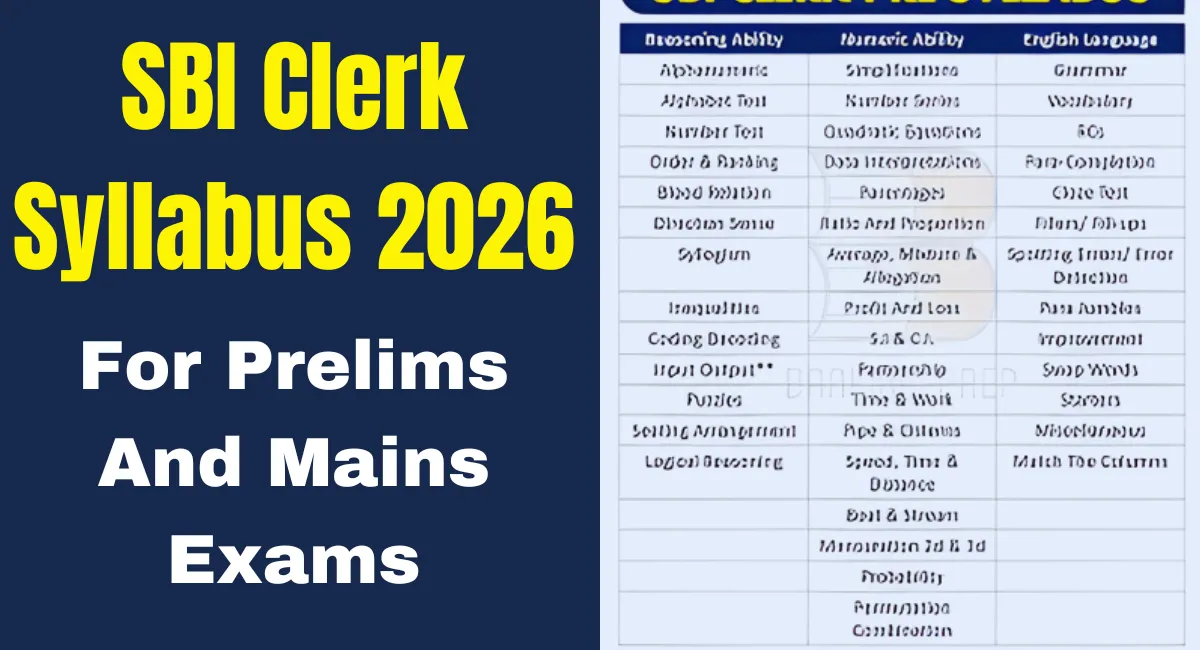
The English Language Section is considered difficult by many students, but if the basics are clear, this section can prove to be high-scoring. Questions in this section are asked from Grammar, Vocabulary, and Comprehension.
The main topics are Reading Comprehension, Cloze Test, Error Detection, Sentence Improvement, Fill in the Blanks, Para Jumble, and Vocabulary-based questions. In Reading Comprehension, short passages are given, and questions related to them are asked.
Vocabulary includes questions related to Synonyms, Antonyms, and Word Meanings. If you develop a habit of reading the newspaper daily and understand the grammar rules well, the English section becomes easier.
Numerical Ability Syllabus for Prelims
In the Numerical Ability Section, calculation speed matters the most. Questions in this section are asked from basic mathematics, but the time is very limited. The main topics are Simplification, Number Series, Percentage, Ratio and Proportion, Average, Profit and Loss, Simple Interest, Compound Interest, Time and Work, Time and Distance, and Data Interpretation.
Data Interpretation includes questions based on Tables, Bar Graphs, and Pie Charts. Practice plays the most important role in this section. The more you practice, the more your speed will improve. Daily calculation practice makes the Numerical Ability Section quite easy.
Reasoning Ability Syllabus for Prelims
The Reasoning Ability Section is logic-based and tests your thinking power. The questions in this section are a bit tricky, but once you understand the pattern, they become easy to solve.
The main topics are Puzzle, Seating Arrangement, Syllogism, Inequality, Blood Relation, Coding Decoding, Direction Sense, Alphanumeric Series, and Logical Reasoning. The maximum number of questions are asked from Puzzle and Seating Arrangement. In this section, speed as well as accuracy are very important. If you solve reasoning questions daily, this section can become scoring.
SBI Clerk Main Exam Syllabus Complete Overview
The SBI Clerk Main Exam is of 200 marks and consists of 4 sections. The Main Exam is the most important stage for final selection. The subjects in this exam are General English, Quantitative Aptitude, Reasoning Ability and Computer Aptitude, and General Awareness.
The level of questions in the Main Exam is more difficult than in the Prelims. Time management is the biggest challenge here. Now let’s understand the syllabus of each section of the Main Exam in detail.
General English Syllabus Main Exam
The General English section is quite important in the Main Exam. This section tests language understanding and vocabulary at a deeper level. The main topics are Reading Comprehension, Vocabulary, Sentence Correction, Para Jumble, Cloze Test, Fill in the Blanks, and Word Usage.
The Reading Comprehension passages in the Main Exam are longer and more conceptual. Vocabulary questions also include words related to banking and current affairs. If a candidate reads editorials daily, this section can become quite strong.
Quantitative Aptitude Syllabus Main Exam
The Quantitative Aptitude section in the Main Exam tests both calculation and concepts. This section has more complex questions compared to the Prelims. The main topics are Data Interpretation, Caselet DI, Simplification, Quadratic Equations, Arithmetic Problems, Probability, Permutation and Combination, and Mensuration.
Data Interpretation questions are quite time-consuming. Therefore, using a smart approach and short tricks is very important. A good score in this section can only be achieved through regular practice.
Read Also-RPF Constable Syllabus 2026 Complete information for you
Reasoning Ability and Computer Aptitude Syllabus
This section is a combination of Reasoning and Basic Computer Knowledge. The Reasoning part includes high-level puzzles and logical questions. The main topics are Puzzles, Seating Arrangement, Input Output, Logical Reasoning, and Data Sufficiency.
The Computer Aptitude section includes questions on Basic Computer Knowledge, Internet, MS Word, MS Excel, Hardware, and Software. The Computer section is easy, but it’s important to know the syllabus. If your computer basics are clear, you can score high in this section.
General Awareness Syllabus Banking and Current Affairs
The General Awareness section is considered the highest-scoring section because it doesn’t involve calculations. This section includes questions from Current Affairs, Banking Awareness, and Static GK. The main topics are Current Affairs of the last 6 months, Banking Terms, RBI Functions, Government Schemes, Financial Awareness, and Important Days. Banking Awareness questions are very important in the SBI Clerk Exam. If you read current affairs daily and follow monthly PDFs, this section can become very strong.
SBI Clerk Preparation Strategy How to prepare effectively
Having a proper strategy is very important to clear the SBI Clerk Exam. First, understand the entire syllabus thoroughly and divide it into smaller parts. Create a daily study plan and give equal time to each subject. Take mock tests regularly and analyze your mistakes. Focus on improving your speed and accuracy. Dedicate extra time to weak subjects and maintain your strong subjects. If you prepare in the right direction, clearing the SBI Clerk Exam is absolutely possible.
Which are the most important topics in SBI Clerk Prelims and Mains?
In Prelims, Reasoning (Puzzle/Seating) and Numerical Ability (DI, Series) are the most important. In English, focus on Reading Comprehension and Cloze Test. In Mains, General Awareness (Current Affairs + Banking) is the most scoring section. Also, practice Reasoning + Computer and Data Interpretation (DI) in Quantitative Aptitude daily.
How many hours should I study daily to prepare for the SBI Clerk Exam 2026?
If you are a beginner, 3 to 4 hours of daily study is sufficient. If your level is good, 2 to 3 hours of smart study is also enough. Make sure to take a daily mock test and analyze it; this helps the most. Maintaining consistency will significantly increase your chances of selection.
Conclusion
If you understand the SBI Clerk Syllabus correctly, half of your exam preparation is already done. This exam is not hard, but the competition is high. With regular study, smart practice, and a positive mindset, any candidate can become an SBI Clerk. If you want to build a career in the banking sector, SBI Clerk is a great opportunity for you. Start your preparation today and take the first step towards your dream job.