

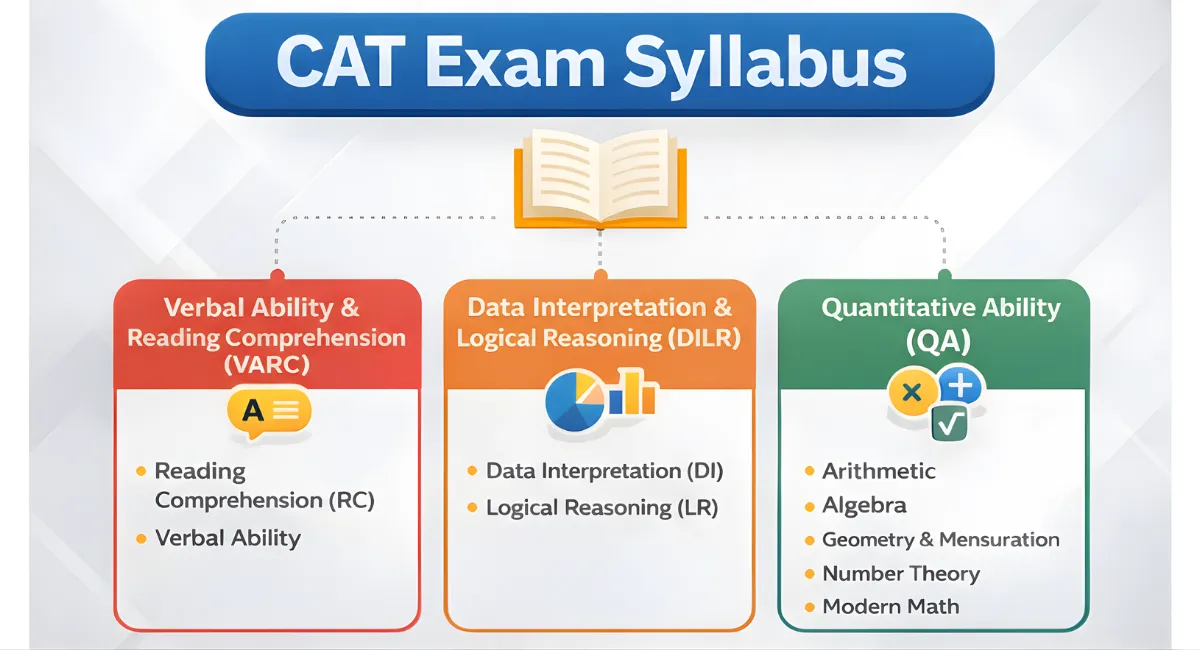
CAT Exam Syllabus: The CAT exam is one of the most popular and challenging entrance exams in India. Every year, lakhs of students take this exam to gain admission to the country’s top MBA programs. CAT stands for Common Admission Test.
The purpose of this exam is to determine whether a candidate is prepared to handle the academic rigors of an MBA program. It doesn’t just test academic knowledge, but also assesses how a candidate observes, thinks critically, and makes sound judgments under time constraints.
The CAT exam syllabus is designed to test our everyday thinking, comprehension, and analytical abilities. Smart preparation is crucial to passing this exam; rote learning simply won’t suffice.
What is CAT?
CAT, or Common Admission Test, is a computer-based exam conducted annually by the IIMs (Indian Institutes of Management). It serves as a gateway to MBA and PGDM programs at the leading IIMs and many other top business schools.
Also Read-Bank Exam Syllabus in Simple Language Complete Guide for Aspirants
The CAT exam is not based on a single subject. It comprises three main sections, each testing different aspects of a candidate’s strengths. A sharp mind, the right strategy, and consistent practice are essential for scoring well on this test. CAT is not just an exam; it can be a pathway to a successful career in the corporate world.
Exam Structure Overview
| Section Name | Topics Covered | Weightage |
| Verbal Ability and Reading Comprehension (VARC) | Verbal Ability, Reading Comprehension | 33% |
| Data Interpretation and Logical Reasoning (DILR) | Data Interpretation, Logical Reasoning | 33% |
| Quantitative Ability (QA) | Arithmetic, Algebra, Geometry, Modern Math, Numbers | 34% |
Detailed CAT Exam Syllabus
Those aspiring to pursue an MBA have widely purchased the CAT exam syllabus materials for every subject. The CAT (Common Admission Test) is an example of an exam that tests analytical and critical thinking skills. It doesn’t just assess academic knowledge but also everyday understanding and logical reasoning.
The CAT examination syllabus clearly outlines the types of questions asked in the exam. Knowing what to study beforehand makes preparation easier. This saves time and eliminates the inefficiency of aimless studying.
The CAT syllabus is designed to develop real-world thinking skills, such as careful reading, accurate answering, and effective time management. If students understand this syllabus well, their confidence gradually increases.
Therefore, as CAT preparation begins, the CAT syllabus is considered the first and most crucial step. It ensures focused study and increases the chances of success.
Verbal Ability and Reading Comprehension (VARC)
Verbal Ability and Reading Comprehension (VARC) is a section of the CAT exam. It assesses how well a candidate can understand and interpret English text.
This section includes comprehension passages and questions related to verbal ability, such as para jumbles and sentence-based questions. Practice makes reading and answering questions in VARC easier.
Reading Comprehension (RC)
Reading comprehension involves long passages. These passages cover various topics, such as society, economics, science, history, and psychology.
Also Read-BSF Paramedical Vacancy 2026, Complete Details of Eligibility, Salary & Selection Process
The questions are based on the passage. The passage must be read carefully, and the correct answer must be marked. The key is to understand the underlying meaning. For success in RC, it is essential to develop a habit of reading newspapers daily, reading short articles, and focusing on the main points.
Verbal Ability
Verbal ability questions relate to language skills, such as: arranging sentences in the correct order, sentence completion, identifying incorrect sentences, and choosing the correct word. This section tests your command of the English language. Regular practice is crucial for improvement.
Data Interpretation and Logical Reasoning (DILR)
Data Interpretation and Logical Reasoning (DILR) is a very important section of the CAT exam. This section tests a student’s logical thinking, analytical ability, and data comprehension skills. It’s not about rote memorization, but about applying the right approach to solve problems.
In Data Interpretation, tables, charts, graphs, and caselets are provided, and questions related to them need to be solved. In Logical Reasoning, questions are asked on topics such as puzzles, arrangements, games, tournaments, and seating arrangements. With practice and the right strategy, a good score can be achieved in the DILR section.
Data Interpretation (DI)
Data Interpretation tests the ability to understand and analyze data. It involves data presented in tables, bar graphs, pie charts, and caselets, and questions related to this data need to be answered. In DI, the focus is more on correct logic and smart approaches rather than just calculations. Practice improves both speed and analytical skills.
Logical Reasoning (LR)
Logical Reasoning tests mental reasoning and problem-solving skills. It includes questions on puzzles, seating arrangements, blood relations, games, and tournaments. Patience, clarity, and logical thinking are required to solve these problems. With proper practice, LR questions become easier.
Quantitative Ability (QA)
Quantitative Ability (QA) is another important section of the CAT exam. This section tests a student’s understanding and problem-solving abilities. It requires applying mathematical concepts to real-life situations.
The QA section includes questions from arithmetic, algebra, geometry, number systems, and modern mathematics. A strong understanding of fundamental concepts, consistent practice, and good calculation speed are essential to solve these problems. With the right strategy, a good score can be achieved in the QA section.
| Topic Name | Sub-Topics Covered | Weightage |
| Arithmetic | Percentages, Profit and Loss, Time, Speed, and Distance, Ratios and Proportions, Simple and Compound Interest, Work and Time, Mixtures and Allegations | 30% |
| Algebra | Linear Equations, Quadratic Equations, Functions, Graphs | 20% |
| Geometry and Mensuration | Area and Volume of 2D and 3D Shapes, Angles, Triangles, Circles, Coordinate Geometry | 25% |
| Number Theory | Divisibility, LCM, HCF, Prime Numbers, Factors, and Multiples | 15% |
| Modern Math | Permutation and Combination, Probability, Set Theory | 10% |
CAT Exam Preparation Strategy
Before starting your CAT preparation, it’s crucial to thoroughly understand the exam pattern and syllabus. It consists of three main sections – VARC, DILR, and QAI. Having complete knowledge of the exam helps you direct your studies effectively.
A strong foundation is essential for success. Initially, it’s important to work on foundational mathematical concepts, quantitative aptitude, and logical reasoning abilities. Without a strong base, further preparation becomes difficult.
CAT is a challenging exam, so developing a daily study habit is highly beneficial. Studying a little bit every day is better, and the study time should be balanced across all three sections.
For the Verbal section, read newspapers, articles, and short stories daily. This improves vocabulary and gradually increases reading speed. Simply reading books isn’t enough. Practice is crucial. Solving questions related to each topic builds confidence and reduces errors over time.
Taking mock tests helps you understand the exam environment. It teaches you how to manage time effectively. Analyzing your mistakes after each mock test is very important.
More attention should be given to subjects that seem difficult. Identifying your weaknesses and working on them significantly helps in CAT preparation.
CAT preparation is a long process, so patience and consistency are essential. Regular hard work and a positive attitude will surely lead to success.
What is the CAT exam syllabus, and what subjects does it include?
The CAT exam syllabus is not entirely fixed, but it remains largely the same every year. The CAT exam has three main sections – Verbal Ability and Reading Comprehension (VARC), Data Interpretation and Logical Reasoning (DILR), and Quantitative Ability (QA).
VARC includes questions on reading comprehension passages, paragraph jumbles, sentence completion, and summaries. DILR comprises questions based on tables, charts, graphs, puzzles, and logical reasoning. QA covers topics such as arithmetic, algebra, geometry, number systems, and modern mathematics. The purpose of this syllabus is to test the student’s understanding, analytical thinking, and problem-solving skills.
Does the CAT exam syllabus change every year, and how should one prepare for it?
The CAT exam syllabus doesn’t change completely every year, but the level and pattern of questions may vary slightly. Sometimes the questions in a particular section are difficult, while at other times they are easier. Therefore, simply memorizing topics is not enough; a thorough understanding of the concepts is crucial.
To prepare for the CAT exam, one should first understand the entire syllabus and build a strong foundation. After that, regular practice, mock tests, and focusing on weak areas are essential. If a student creates the right strategy based on the syllabus and practices consistently, achieving a good score in the CAT exam is possible.
Conclusion
Thoroughly understanding the CAT exam syllabus is the first step towards success. If a student prepares with the right plan, consistent practice, and the right mindset, even an exam like CAT can be easily cleared. CAT is not just an exam; it’s an opportunity to fulfill your dreams. With hard work in the right direction, success is guaranteed.